

ABOUT THE CLIENT:
The largest company with its own production and delivery of products throughout Belarus using more than 120 machines.
The company confidently uses automation systems for the work of specialists at many levels, including the work of logisticians. Geographically the production location is Minsk, as well as branches in all regional centers. Sales are carried out independently without the involvement of dealers.
WHAT WAS THE BUSINESS CASE AND ITS OBJECTIVE:
Expectation
Being completely convinced of the efficiency of the existing system at the enterprise, the general director invited INFINIUM specialists to conduct a logistics audit, primarily to automate the work of logisticians. At the same time, the company’s management DOUBTED from the very beginning that the use of the LOGIMUS Logistics Optimization System of the INFINIUM platform would provide any savings.
Responsibility for cost management in the company was assigned to the heads of logistics departments, as well as to the logisticians themselves, who were already using an expensive module from SAP.
Reality
As it turned out, in fact, there was no talk of any INTELLIGENT logistics from SAP. Logisticians simply looked through the list of orders from different stores and, relying on intuition, figured that if there was an order from one store in the village of Kolodishchi, then by arranging the orders “on the knee” by address, they could start delivery to another store in the same village. Elementary logic – add another order to the same machine. Thus, logisticians spent time, going through a list of thousands of orders from different stores, and “throwing” orders into cars manually.
STEP-BY-STEP AUDIT AND MODELING DATA OF THE EFFECT OF AUTOMATION
STEP 1. Agreement on audit criteria and conditions
A typical Minsk delivery region was proposed for analysis. It includes the city of Minsk and the entire Minsk region.
The customer deliberately chose one of the least busy days of the year for testing. This is justified by logic – on a heavily loaded day, logisticians can make mistakes, but on a lightly loaded day, logisticians work at their best. And if invited INFINIUM specialists can find suboptimalities even on a lightly loaded day, it means that on a highly loaded day there will certainly be a lot of errors. Therefore, the work of logisticians must be automated.
STEP 2. Conducting an audit according to specified criteria
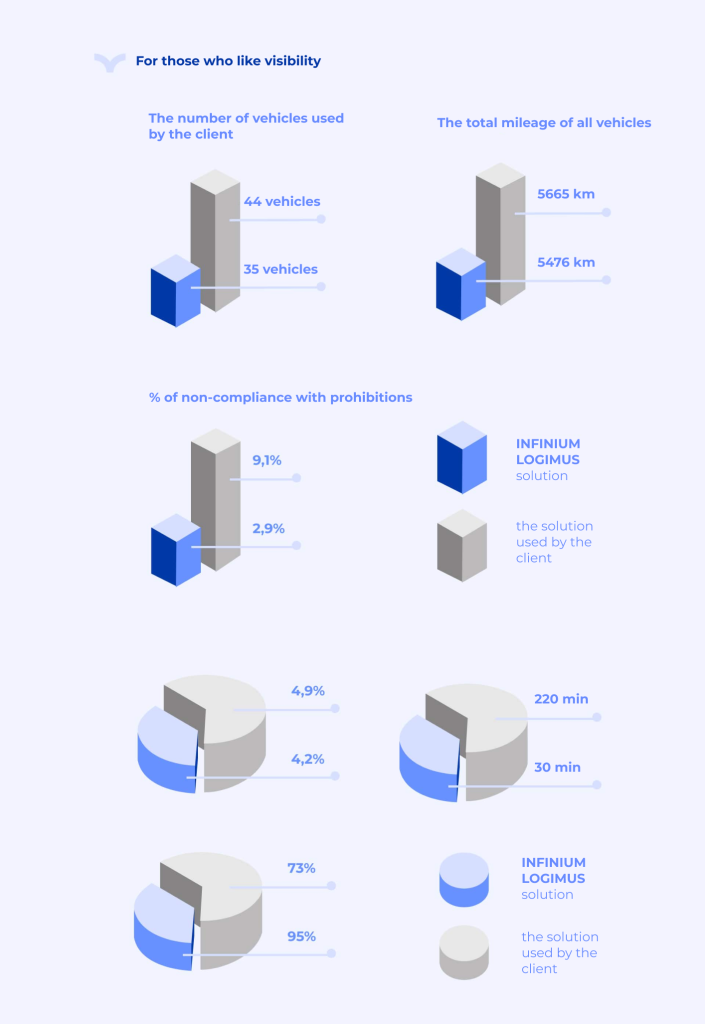
On the day under study in the Minsk region, logisticians actually used 44 trucks for delivery, which delivered products to about 1,000 points and traveled a total of 5,661 km.
And already at the initial stage, our expert auditors discovered many errors:
- prohibitions on the entry of certain cars into certain stores (mismatch between ramps and tail lifts/roller shutters, etc.) were violated in 9.1% of cases (4 out of 44 cars),
- time intervals were not respected in 4.9% of cases (46 out of 945 points).
- The vehicle utilization (filling) rate was on average 73%.
This CONFIRMED once again: even the most EXPERIENCED LOGISTICS cannot keep all the information in their heads, which is why the quality of delivery and the efficiency of resource use suffers.
STEP 3. Scenario using the LOGIMUS Optimal Logistics System based on the received data
When loading data into the System, INFINIUM employees took into account:
- bans on inconvenient access to stores
- prohibitions on non-compliance of the ramp with the tail lift
- location of truck body roller shutters
- time intervals
- minimum mileage expenses and cost of using the car
- and other relevant criteria
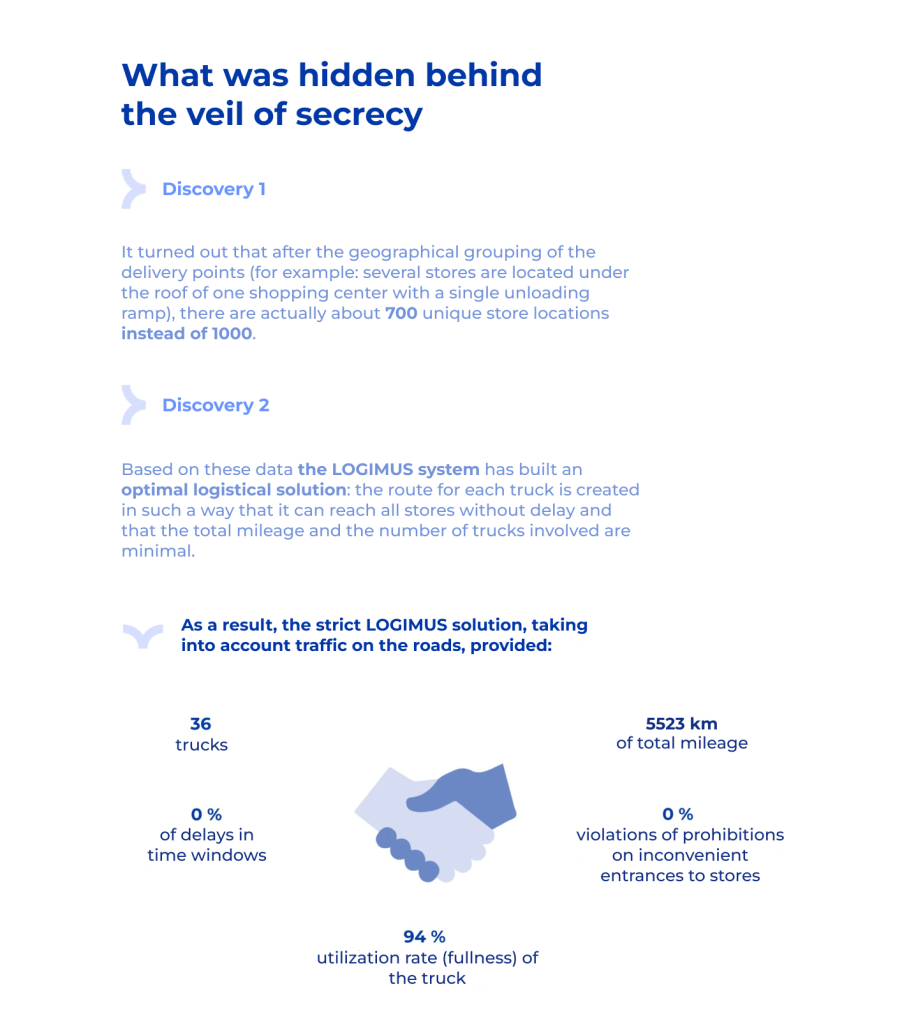
ALTERNATIVE
But I didn’t want to stop there. INFINIUM specialists reasoned as follows: the company has developed a practice of being late during time intervals and violating prohibitions on inconvenient entries. This is considered acceptable – neither customers nor drivers complained. This means that the LOGIMUS System can also be allowed to build an optimal solution with a small number of delays and violations (but no more than the historically established percentage of these delays and violations in the enterprise).
As a result, the LOGIMUS System built an alternative solution:
- 35 trucks,
- 5476 km total mileage,
- 4.2% deviations from time intervals,
- 2.9% violations of prohibitions,
- 95% truck utilization (fullness) rate.
WHAT THE RESULT DID THE CLIENT GET?
Having calculated the economic effect, which we achieved not on an imaginary hypothesis, but on actually obtained data, we received a result not just consisting of dry numbers, but with the unique knowledge of specialists that are not digitized.
In a comparable (and even lower) percentage of time interval violations and bans, the LOGIMUS System required 20.5% fewer trucks and 3.3% fewer runs.
Based on the fact that one truck costs an enterprise $152 per day in fixed costs, the savings by removing 9 trucks (44-35) from the delivery process is $1,368 per day. In addition, the total mileage in the region is reduced by 185 km (5661-5476), which saves an additional $250.
Total: $152 X 9 trucks + $250 = $1618/day
The total savings for the Minsk delivery hub alone amounted to $1,618/day on the least busy day. On an average busy day of the year, delivery is 1.3 times higher. This means that the number of cars and mileage increases by 1.3 times on an average annual day. Accordingly, the savings will be 1.3 times greater – $2103.4/day.
The total daily delivery throughout Belarus for this company is 3 times more than delivery within the Minsk hub. That is, the total savings per day of delivery across the country will be $6,310/day.With 312 delivery days per year, the LOGIMUS System reduces vehicle usage and total miles traveled, resulting in annual savings of $1,969,782.
All routes proposed by the LOGIMUS System of the INFINIUM platform were considered realistic, there were no traffic violations, and the speeds of travel between stores exactly corresponded to the speeds of traffic flows for this type of vehicle.
CONCLUSIONS IN PURE FORM
The CEO was surprised only by the annual savings figure itself (about 2 million US dollars). Since, according to the internal accounting system in ERP, all transport costs of the enterprise for the year were only a couple of times higher.
As a result, it turned out that their own transport workers had “cheated” at one time: they ensured that not all expenses for maintaining their own transport were classified as such expenses in ERP. Most of the costs of maintaining transport were allocated to the production of the products themselves.
Meanwhile, it is obvious that the costs of maintaining transport include everything that would disappear if the transport and its supporting infrastructure were sold (including repair areas, parking lots, buildings and structures for car maintenance, various third-party repair services, insurance, etc.) , the dismissal of drivers and a significant part of other personnel who would not be needed when selling their vehicles, as well as part of the overhead costs and taxes on their salaries related to these employees.
As a result, no matter how efficient and automated the enterprise may seem, we should not forget that people manage all this information. And if the system is designed only to automate accounting and speed up the exchange of information, then this does not at all guarantee the adoption of the MOST EFFECTIVE DECISIONS.
Real automation begins where some decisions are made by proven mathematical algorithms that can accurately take into account a huge number of significant criteria.
This example shows that there is an effect where it was NOT OBVIOUS at first glance and a company can REALLY save up to $2,000,000 using the LOGIMUS System of the INFINIUM Platform.