

ABOUT THE CLIENT
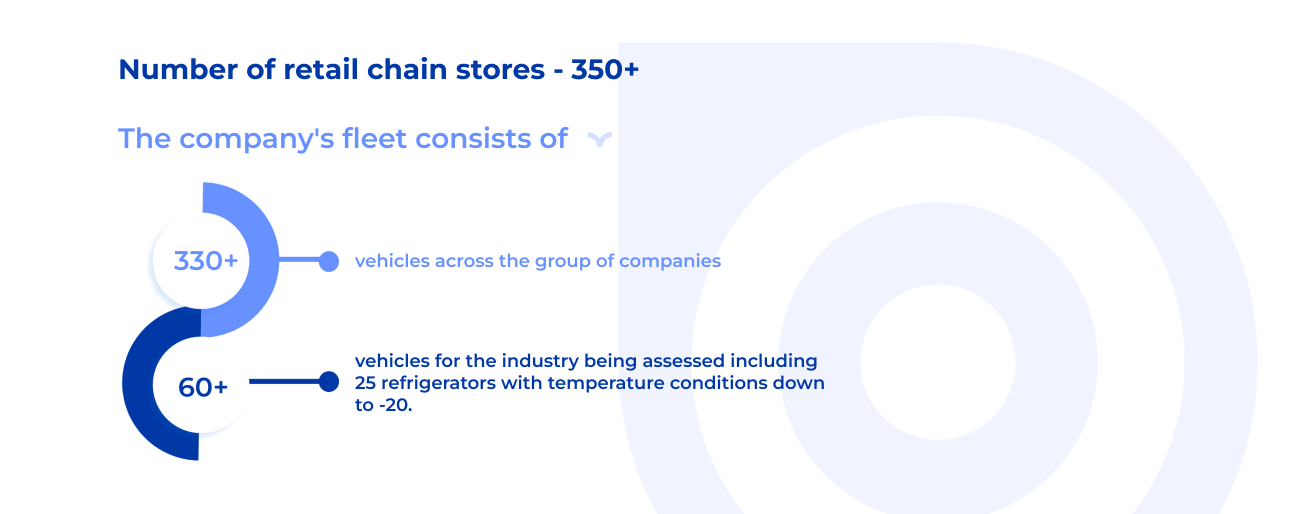
A private Belarusian production and trading group of companies with a branch network throughout the Republic of Belarus. The main line of business is own production, retail and wholesale trade in food products (canned food, preserves, frozen products and semi-finished products, chilled products, dairy products, etc.).
CUSTOMER REQUEST
▶ Automate the work of the branch logistician to reduce the load on the specialist
▶ Digitize the work of a logistician to be able to calculate transparent motivation
Assessment of client’s business processes at the initial stage
Infinium specialists conducted a superficial screening of the branch’s processes and analyzed data from the client’s current monitoring system. As a result, problematic issues were identified in the work of the customer’s logistics department:
- Drivers’ work schedule – from 7.5 to 14.5 hours a day
- Unreasonable delays in queues
- Arrivals at the same objects by 3-5 cars per day
- Lack of order parameters such as weight and volume of cargo
- Low “recycling” of transport (35-55%, with the norm being 75-80%)
- Lack of temperature control in the car body to optimize the delivery of frozen products
- Completely manual route building
- Lack of work automation tools – all object parameters (time intervals, volumes, object “loyalty”, priority, etc.) are stored and processed “in the head” of the logistician
- Lack of geodata for objects
- Absence of both plan-factorial and any other analysis
- Work with paperwork (tasks for the day, travel documents, etc.), communication with the driver through various (up to 4) communication channels by specialists from different departments (logistician, mechanic, accountant, salesperson)
Infinium specialists conducted an analysis that revealed preliminary savings.
In addition, the missing disparate data from various departments of the customer was collected and grouped, which was loaded into the TMS Logimus system “as is”, without additional processing. As a result, the following preliminary calculations were obtained:
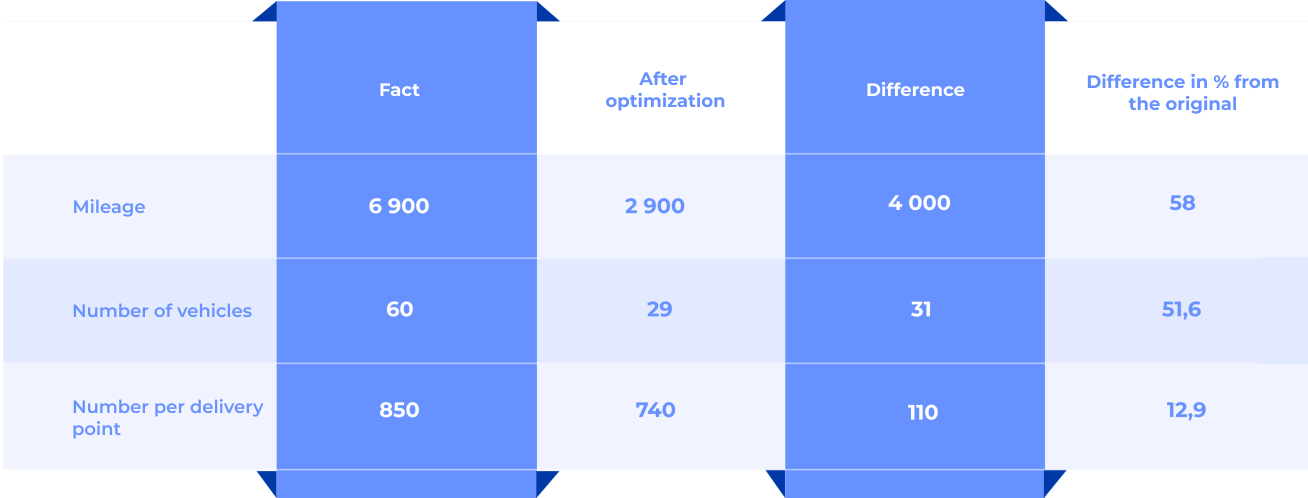
Considering that the average cost of 1 km of mileage for companies with a similar vehicle fleet is $1, and one day of vehicle operation is an average of $106, simple mathematical calculations show the potential benefit of using the TMS Logimus system in the amount of more than $2.5 million per year. year! And this is only for one branch!
HOW DOES IT WORK?
The unique algorithm of the TMS Logimus system compares:
▶ All vehicles available during the planned period, taking into account their capacity (tonnage and volume), temperature conditions for cargo transportation, and drivers’ work schedule
▶ Weight and volume of cargo, order compatibility, priority of deliveries, time windows for delivery of orders
▶ Opening hours of warehouses, working hours of recipients, restrictions on vehicle access to the facility, unloading time at the facilities
▶ Transport traffic on the analyzed day
Based on the results of this analysis, Artificial Intelligence builds routes, minimizing mileage and the amount of necessary transport.
The logistics specialist can, if necessary, manually adjust such parameters as:
▶ Grouping of routes
▶ Allowable time of delays to recipients and to the warehouse
▶ Distribute the load evenly among drivers
▶Assess the cost and effectiveness of each route to obtain maximum benefits
PROJECT IMPLEMENTATION
- Understanding the economic feasibility and high return on investment of this project, the customer requested a full audit of logistics and related processes. The result of the analysis was a detailed conclusion (TOR) on changing the customer’s current processes, introducing specific tools (solutions) based on TMS systems and implementing plan factor analysis in the company’s logistics department.
- The next step was to purchase the necessary software product – TMS Logimus with flexible functionality:
▶ “Routing” module with a mobile application for drivers
▶ Package of points for building routes
▶ A set of reports and Dashboard for the Manager
▶ Temperature Telematics
- Next, work was carried out to integrate the product into the company’s current ERP system (1C), the necessary reports were set up, as well as KPI calculations for employees.
- Also, the staff of the logistics department and drivers of the customer company underwent extensive training, followed by passing tests on the ability to use and configure the system.

IMPLEMENTATION RESULTS
▶ Route construction time has been reduced from 2-2.5 hours to 15-20 minutes
▶ Strict adherence to temperature conditions for product transportation has been established
▶ There is now strict adherence to drivers’ work and rest schedules
▶Plan-factor analysis of routes, mileage and costs associated with product delivery was implemented
▶ Obtained transparent KPI for logisticians and drivers
▶Full analytics of all stages of product delivery have appeared (time of loading and unloading at sites, statuses of delivery stages, analysis of overruns, delays, deviations from routes, etc.)
BENEFIT
Intermediate savings from implementing TMS Logimus after six months of work amounted to about $350,000.
The cost recovery for the implementation and use of the system was 3 months from the moment the project was launched in pilot mode.